
Beyond the Venture Studio Hype: What Corporate Venture Building Actually Requires
Half of all CEOs now rank venture building as a top-three priority. Yet the gap between expert and novice builders is exponential: 12x more value, 2x success rate. The difference is not ideas — it is capability.
Corporate venture building is having its moment. Half of all CEOs surveyed in McKinsey's fifth annual global study now view new-venture development as one of their top three strategic priorities [1]. The logic is compelling: in a world where organic growth is increasingly difficult and acquisition multiples remain elevated, building new businesses from within offers a path to diversification that is both capital-efficient and strategically coherent.
Yet the gap between aspiration and execution in corporate venture building is vast. While the most experienced builders report twice the success rate and 2.8 percentage points higher organic growth than novices [1], the majority of corporate ventures never reach meaningful scale. The venture studio model — once heralded as the answer to corporate innovation inertia — is itself under pressure, with industry observers estimating that a significant share of studios launched in the past five years will fail to survive [2].
The question is no longer whether corporations should build ventures. It is whether they understand what venture building actually requires.
The Maturity Divide
McKinsey's longitudinal data reveals a striking bifurcation in corporate venture building. On one side, a growing class of "expert builders" — companies with mature support structures, dedicated talent, and serial building capabilities — are generating outsized returns. On the other, a much larger group of "novice builders" are investing in venture building without the infrastructure to succeed.
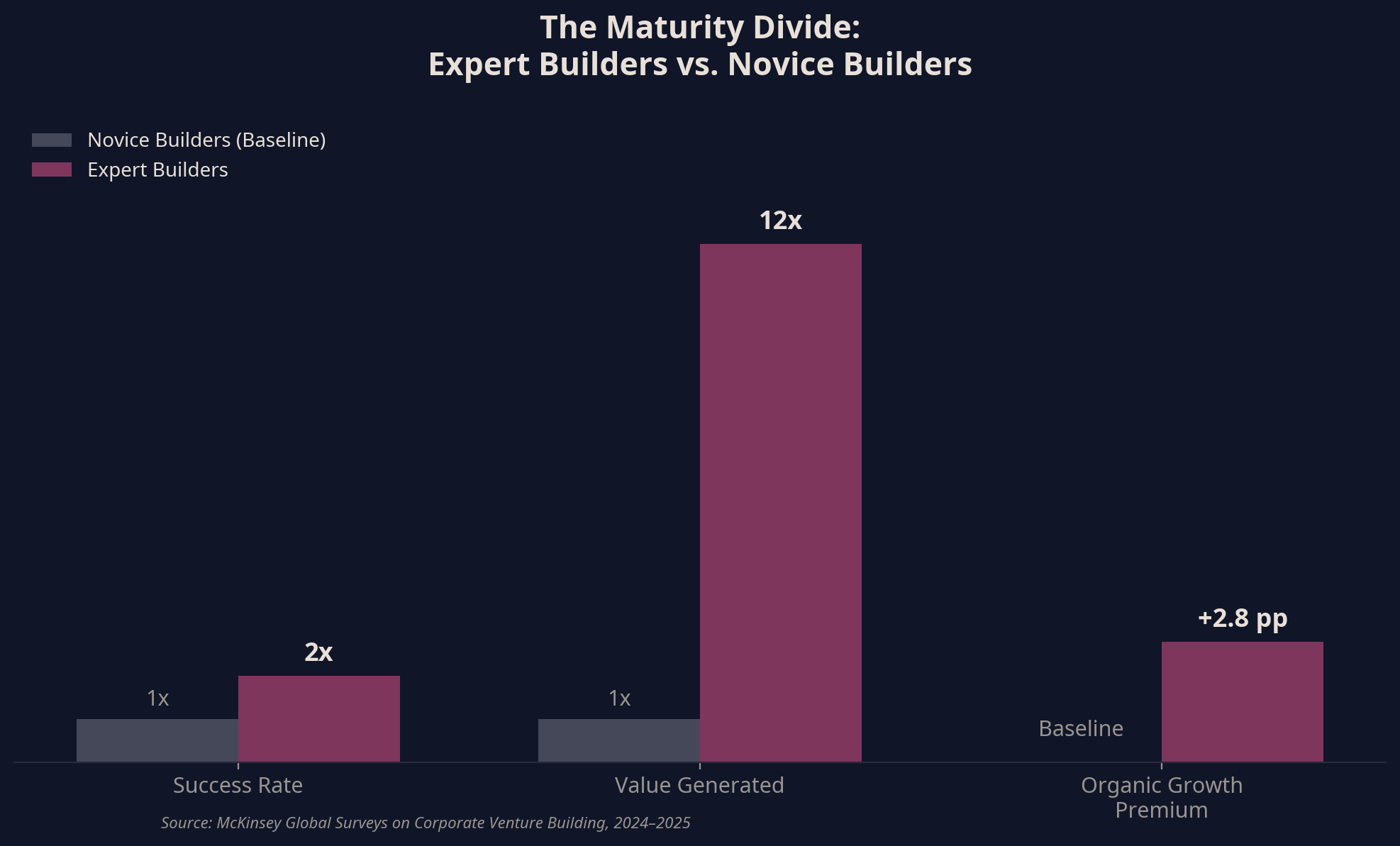
The performance gap between these two groups is not marginal; it is exponential. According to McKinsey's 2025 research, the most experienced builders are 2x as likely to see success and, on average, see 12x more value from their ventures than novice builders [3]. Furthermore, 72% of respondents whose companies built ventures with mature capabilities report above-average growth [4].
Metric: Success rate (meeting/exceeding expectations) | Expert Builders: 2x higher | Novice Builders: Baseline
Metric: Value generated | Expert Builders: 12x more | Novice Builders: Baseline
Metric: Organic growth premium | Expert Builders: +2.8 pp | Novice Builders: —
Metric: Above-average growth reported | Expert Builders: 72% | Novice Builders: Significantly lower
Source: McKinsey Global Surveys on Corporate Venture Building, 2024-2025 [1][3][4]
This data challenges a common assumption: that venture building is primarily about having good ideas. It is not. It is about having the organizational capability to take ideas from zero to scale — repeatedly.
Why Most Corporate Ventures Fail
The failure modes of corporate venture building are well-documented, but they share a common root cause: incompleteness. Corporate ventures typically fail not because the market opportunity was wrong, but because the execution model was fragmented.
The strategy-without-execution trap. Many corporate ventures begin with a compelling strategic thesis — a market gap, a technology trend, a customer need — but lack the operational capability to build a product, acquire customers, and iterate at startup speed. The strategy is sound; the execution never materializes.
The technology-without-business-model trap. Conversely, some ventures are driven by technology teams that build impressive prototypes but never develop a viable business model. The product works; the business does not.
The organizational antibody problem. Even when a venture has both strategy and execution capability, it must survive within a corporate environment that is structurally hostile to new businesses. Procurement processes, compliance requirements, brand guidelines, and internal politics create friction that can slow a venture to the point of irrelevance. Harvard Business School research by Shikhar Ghosh found that 75% of venture-backed companies never return cash to investors [5] — and corporate ventures face all the same challenges plus the additional burden of organizational resistance.
The handoff problem. Perhaps the most insidious failure mode is the handoff. A strategy team defines the opportunity. A design team creates the concept. A technology team builds the MVP. A business team is assigned to scale it. At each handoff, knowledge is lost, momentum dissipates, and the venture loses the coherence that made it promising in the first place.
What Expert Builders Do Differently
McKinsey's research identifies several structural differences between expert and novice builders that explain the performance gap.
They invest meaningfully. Companies that allocate at least 20% of their growth capital to building entirely new ventures achieve revenue growth that is two percentage points higher than companies that do not invest in venture building [1]. This is not a rounding error — at enterprise scale, two percentage points of revenue growth represents billions in value creation.
They build serially, not episodically. Expert builders treat venture building as a repeatable capability, not a one-off experiment. They develop institutional knowledge about what works — which market signals to trust, how to structure teams, when to pivot, when to kill — and they apply that knowledge across multiple ventures simultaneously. The most striking finding from McKinsey's data is that the largest new ventures built by incumbent companies in the past decade have achieved 1.5x the revenue of the largest startups [1]. Scale incumbents, when they build well, can outperform even the most successful startups.
They maintain full-stack capability. The expert builders do not outsource critical capabilities. They maintain integrated teams that span strategy, design, technology, and go-to-market — reducing handoffs and preserving the coherence that is essential to venture success. This is not about doing everything in-house; it is about ensuring that the critical path from insight to market is owned by a single, accountable team.
They separate but connect. Successful corporate ventures operate with sufficient autonomy to move at startup speed, but maintain strategic connection to the parent company's assets, distribution channels, and domain expertise. This balance — separate enough to be agile, connected enough to leverage unfair advantages — is the defining characteristic of expert builders.
The Venture Studio Question
The venture studio model emerged as an attempt to institutionalize these principles. By creating a dedicated entity focused on serial venture creation, studios promised to bring startup methodology to corporate innovation at scale.
The model has genuine merit. Studios can develop specialized expertise in the zero-to-one phase of venture creation, build reusable infrastructure (legal templates, technology platforms, go-to-market playbooks), and attract entrepreneurial talent that might not thrive in a traditional corporate environment.
But the studio model also has a critical vulnerability: it often reproduces the fragmentation problem it was designed to solve. Many studios operate as external entities that hand off ventures to the corporate parent once they reach a certain stage — recreating the same handoff problem that plagues traditional innovation. Others lack the strategic depth to identify opportunities that are truly aligned with the parent company's competitive advantages, resulting in ventures that are technically viable but strategically orphaned.
The studios that succeed are those that function as integrated capability platforms rather than as separate idea factories. They maintain deep strategic connection to the parent company's business, they own the full stack of venture creation from insight to scale, and they build institutional knowledge that compounds over time.
The Gen AI Opportunity
Generative AI is reshaping the venture building landscape in ways that amplify both the opportunity and the risk. McKinsey's survey finds that 60% of respondents are eager to pursue gen-AI-enabled ventures in the next five years [1]. The technology enables faster prototyping, more efficient customer discovery, and lower-cost MVPs — all of which reduce the capital required to test new venture hypotheses.
But AI also raises the stakes for execution capability. When the cost of generating ideas and prototypes approaches zero, the competitive advantage shifts entirely to execution — to the ability to take a concept from prototype to product-market fit to scale. Companies that lack integrated execution capability will find themselves drowning in AI-generated concepts that never reach market.
The BCG Innovation Study confirms this dynamic: while 86% of organizations are experimenting with GenAI for innovation, only 8% are applying it at scale [6]. The gap between experimentation and impact is, once again, an execution gap.
Building the Capability, Not Just the Venture
The data is clear: corporate venture building works, but only when it is treated as a capability to be developed rather than an activity to be outsourced. The companies that generate the most value from venture building are those that invest in the organizational infrastructure — the talent, the processes, the governance, the culture — that enables serial, integrated venture creation.
For companies considering their venture building strategy, the evidence suggests three priorities:
First, commit to integration over fragmentation. The single greatest predictor of venture success is the coherence of the team executing it. Strategy, design, technology, and go-to-market must operate as a unified capability, not as a relay race between specialists.
Second, invest in the capability, not just the venture. Individual ventures may succeed or fail, but the organizational capability to build ventures is a durable asset. Companies that invest in building this capability — through dedicated teams, repeatable processes, and institutional learning — see compounding returns over time.
Third, leverage your unfair advantages. The reason corporate ventures can outperform startups is that they have access to assets — customer relationships, distribution channels, domain expertise, brand trust, data — that startups cannot replicate. The best corporate ventures are those that are strategically designed to exploit these advantages.
The venture studio hype cycle is maturing. What remains is a clear-eyed understanding that venture building is not a shortcut to growth — it is a discipline that rewards completeness, integration, and sustained commitment.
References
[1] McKinsey & Company, "How CEOs Are Turning Corporate Venture Building into Outsize Growth," Fifth Annual McKinsey Global Survey on New-Venture Building, October 2024. https://www.mckinsey.com/capabilities/business-building/our-insights/how-ceos-are-turning-corporate-venture-building-into-outsize-growth
[2] Medium, "Why 70% of Venture Studios Will Fail by 2026," August 2025. https://medium.com/@ethanjohn.studio/why-70-of-venture-studios-will-fail-by-2026-and-how-to-build-one-that-survives-098eee82201e
[3] McKinsey & Company, "The Three Building Blocks of a Successful Venture Factory," May 2025. https://www.mckinsey.com/capabilities/business-building/our-insights/the-three-building-blocks-of-a-successful-venture-factory
[4] McKinsey & Company, "The Way to Win in Corporate Venturing: Serial Building and AI," October 2025. https://www.mckinsey.com/capabilities/business-building/our-insights/the-way-to-win-in-corporate-venturing-serial-building-and-ai